Voices in Action: AI-Powered Insights from Corporate Messaging During Societal Crises Doctoral defense · University of Amsterdam · Amsterdam Business School 30 June 2026 · Agnietenkapel


About the Dutch defense tradition

Dutch PhD defenses are formal public ceremonies held in centuries-old academic chapels. In general, the candidate is opposed for one hour by a committee of five to eight professors, each questioning the work in turn. Two paranymphs stand beside the candidate throughout. The Beadle (Pedel) opens and closes the ceremony, carrying the university mace, and calls “Hora est” precisely one hour in, ending questions mid-sentence if necessary.

My defense was held at the Agnietenkapel, a 15th-century Gothic chapel and the birthplace of the University of Amsterdam. The Athenaeum Illustre, the university’s direct predecessor, opened there on 8 January 1632, when Gerardus Vossius delivered his inaugural lecture. The chapel has hosted UvA’s academic ceremonies ever since.

On paranymphs

The word paranymph comes from the Ancient Greek paránymphos (παράνυμφος), meaning “beside the bride”, originally a wedding attendant who accompanied the bridegroom. The tradition entered Dutch academia through the older metaphor of a doctorate as a de facto marriage to the university.

Historically, paranymphs had a substantive role. According to accounts preserved by Dutch universities and academic historians, they could “act as a backup for the doctoral candidate to ask for advice when answering questions, or even take over answering the questions.” Folklore also describes them as protective attendants in an era when defenses were more contentious. Today, the role is ceremonial, comparable to a best man or bridesmaid at a wedding, and paranymphs stand beside the candidate as a public gesture of support.

At my defense, my paranymphs were my husband, Daniel Hamelberg, and my friend, Dr. Gabriella Guinlle.—

The ceremony

Beadle carrying the University of Amsterdam mace enters the Agnietenkapel Paranymph Gabriella Guinlle addressing the audience at the opening of the layman's talk
The Beadle opens the ceremony. My paranymph Gabriella Guinlle addresses the audience at the start of the layman’s talk.

The layman’s talk

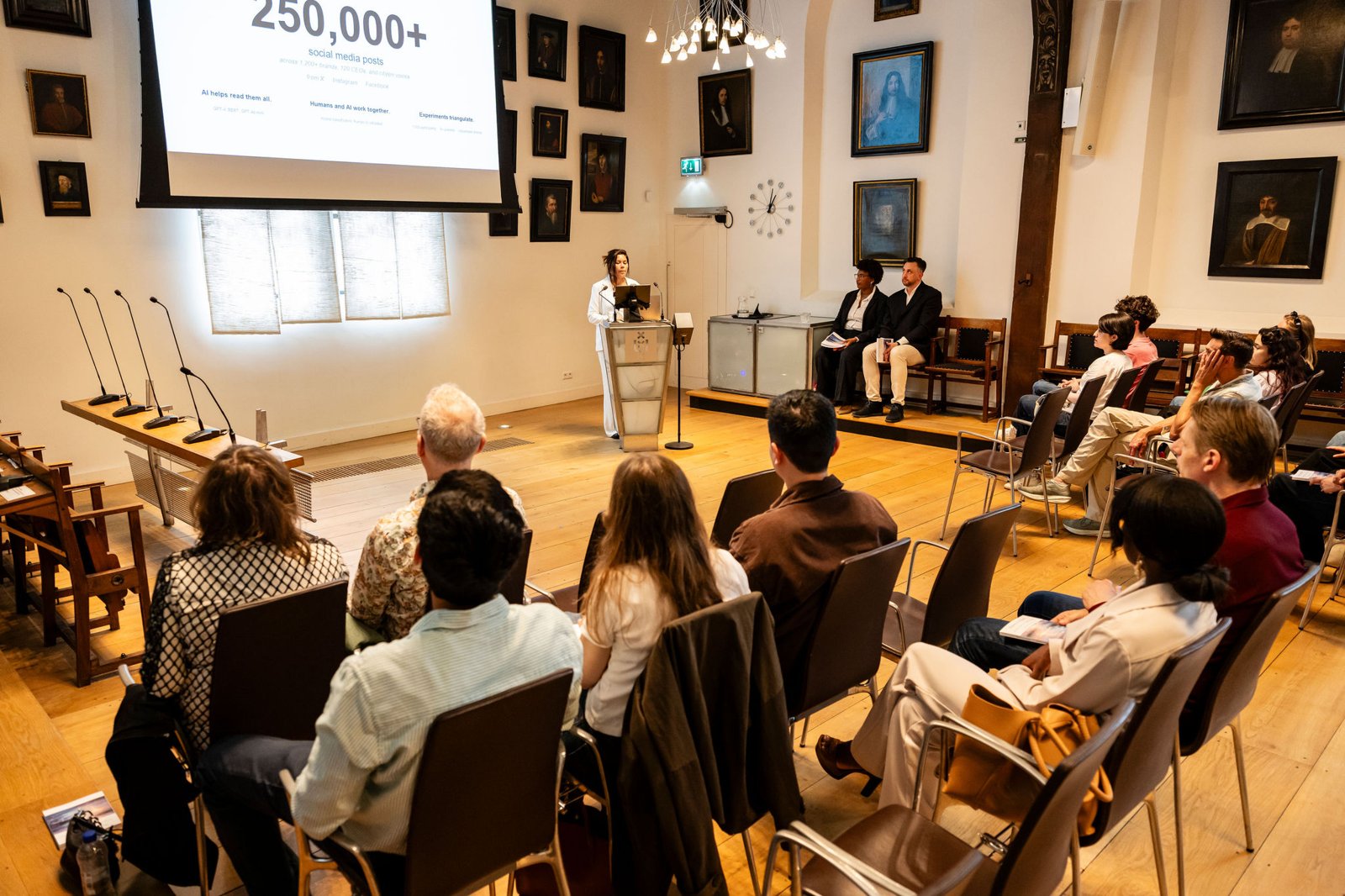
Every UvA defense opens with a layman’s talk: a short public lecture the candidate gives to explain the dissertation in plain terms to the audience, which typically includes family, friends, and visitors from outside the field. It is introduced by one of the paranymphs, who steps to the microphone two minutes before the hour, before the committee has entered the room. The talk lasts about ten minutes, and must end by twelve minutes past the hour. Only then does the formal opposition begin. Kedma Hamelberg at the podium presenting research on 250,000+ social media posts

My talk began where the dissertation began: in September 2021. At the time, it felt like the world was in the final leg of the pandemic as masks were coming off and schools were reopening. It turned out to be the beginning of a sequence of crises, not the end of one. In the years since, my research has sought to understand how corporations communicate in times of crisis.

Three contexts shaped the dissertation:

  • The Russia–Ukraine war (Chapter 2): should the CEO speak on their own social media account, or the company on the brand’s? Findings suggest CEO and brand voices are two different tools for two different goals — CEO voices generate more engagement, especially on distant suffering, while brand voices better mobilise citizens to act when the issue hits close to home.
  • The DEI debate (Chapter 3): citizens acted strongly, but not always as one might expect. When brand stances and citizen posts aligned pro-DEI, audiences rewarded the brand; when they aligned anti-DEI, audiences punished it. Alignment alone was not enough; the direction of alignment mattered. No neutral move.
  • Sustainable Development Goals and emojis (Chapter 4): When brands speak about causes far from what they usually do, engagement drops. Can something as small as an emoji help close that gap? Findings suggest that a symbol emoji that stretches meaning (a Pride flag next to “Love wins”) narrows the gap; an emoji that only repeats what the text already says does not.

Three different contexts. One underlying question: when the world is in crisis, whose voices and message design actually shape what happens next?

The defense

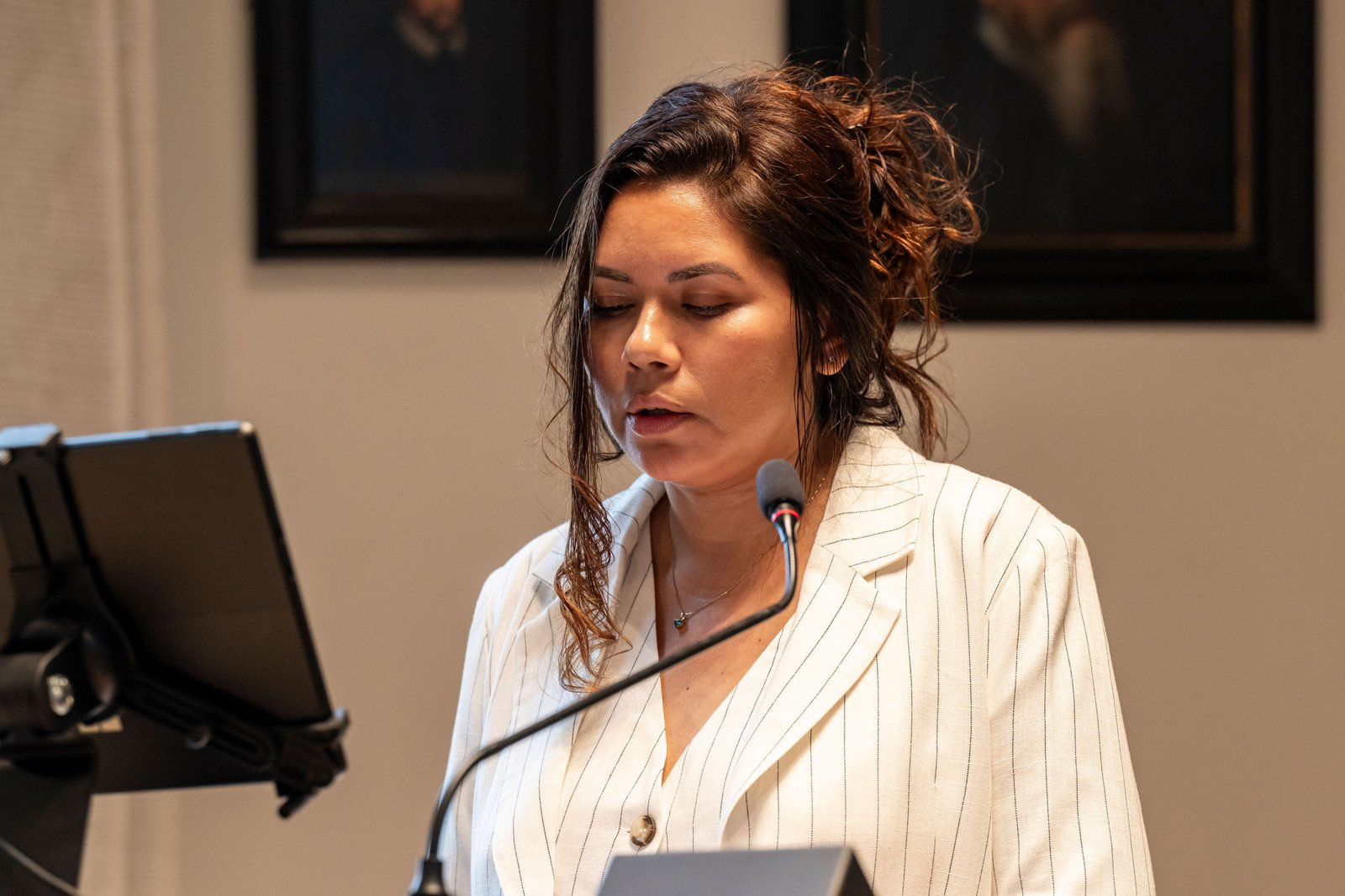
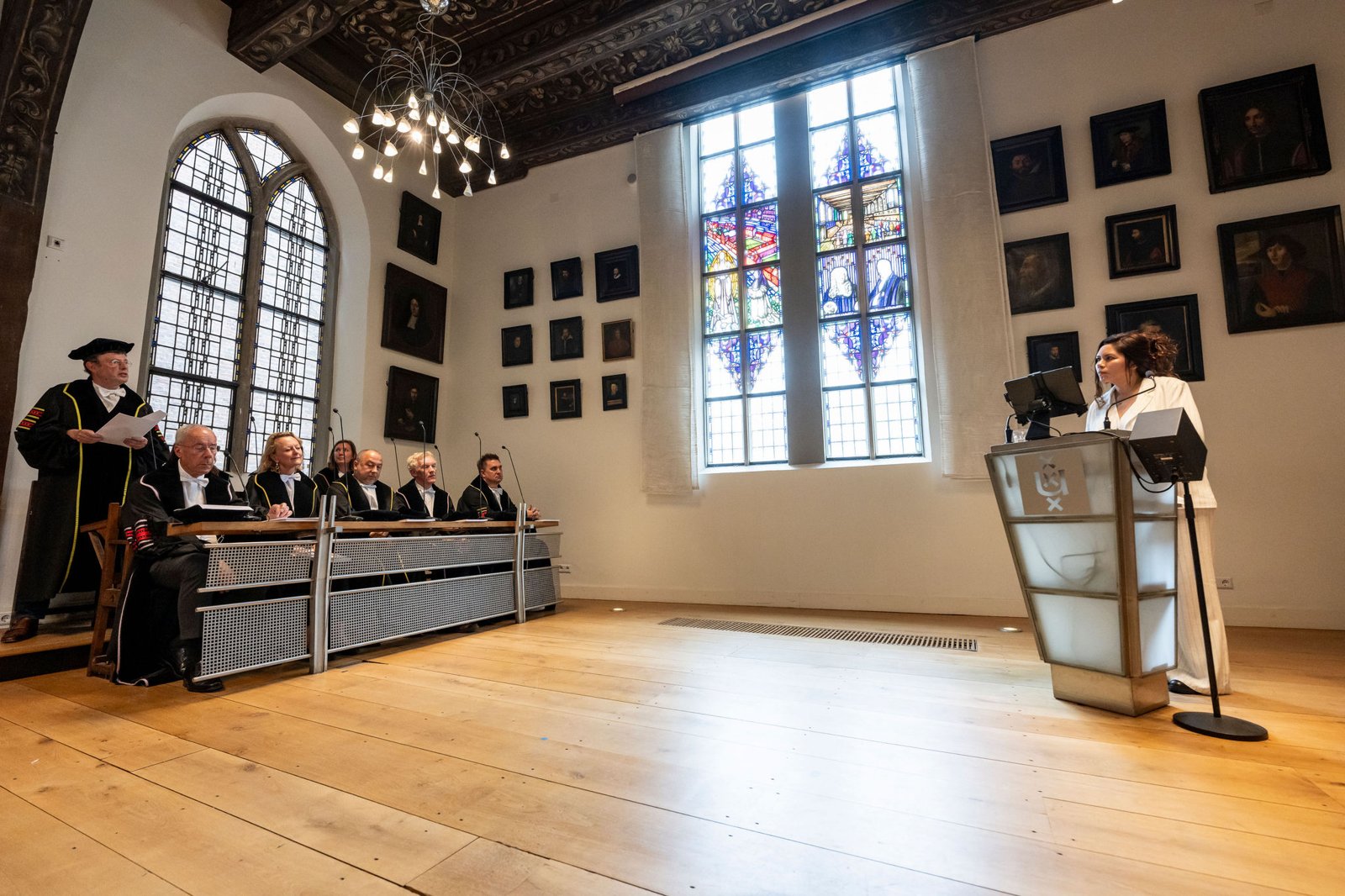
Wide view of the defense with committee seated across from the candidate Kedma Hamelberg Close-up of Kedma Hamelberg speaking at the podium Kedma Hamelberg in profile with historical portrait behind
One hour of formal opposition. The committee questions the work in sequence.

The opposition

Each committee member took the floor in turn.

Prof. Ronald Does, voorzitter of the defense committee Prof. Marc Salomon, Dean of the Amsterdam Business School Prof. Corine Boon Prof. Raoul Kübler Dr. Bernadette van Ewijk Prof. Francesca Sotgiu
The committee members who opposed the work.

The committee

The defense committee, whose questions elevated the work:

  • Prof. dr. Ronald Does (voorzitter / chair)
  • Prof. dr. Marc Salomon (Dean, Amsterdam Business School)
  • Prof. dr. Corine Boon (University of Amsterdam)
  • Prof. dr. Raoul Kübler (ESSEC Business School)
  • Prof. dr. Francesca Sotgiu (Vrije Universiteit Amsterdam)
  • Dr. Bernadette van Ewijk (University of Amsterdam)
Kedma Hamelberg defense committee standing in academic gowns Kedma Hamelberg standing with the PhD committee
The defense committee in academic gowns.

The verdict and conferral

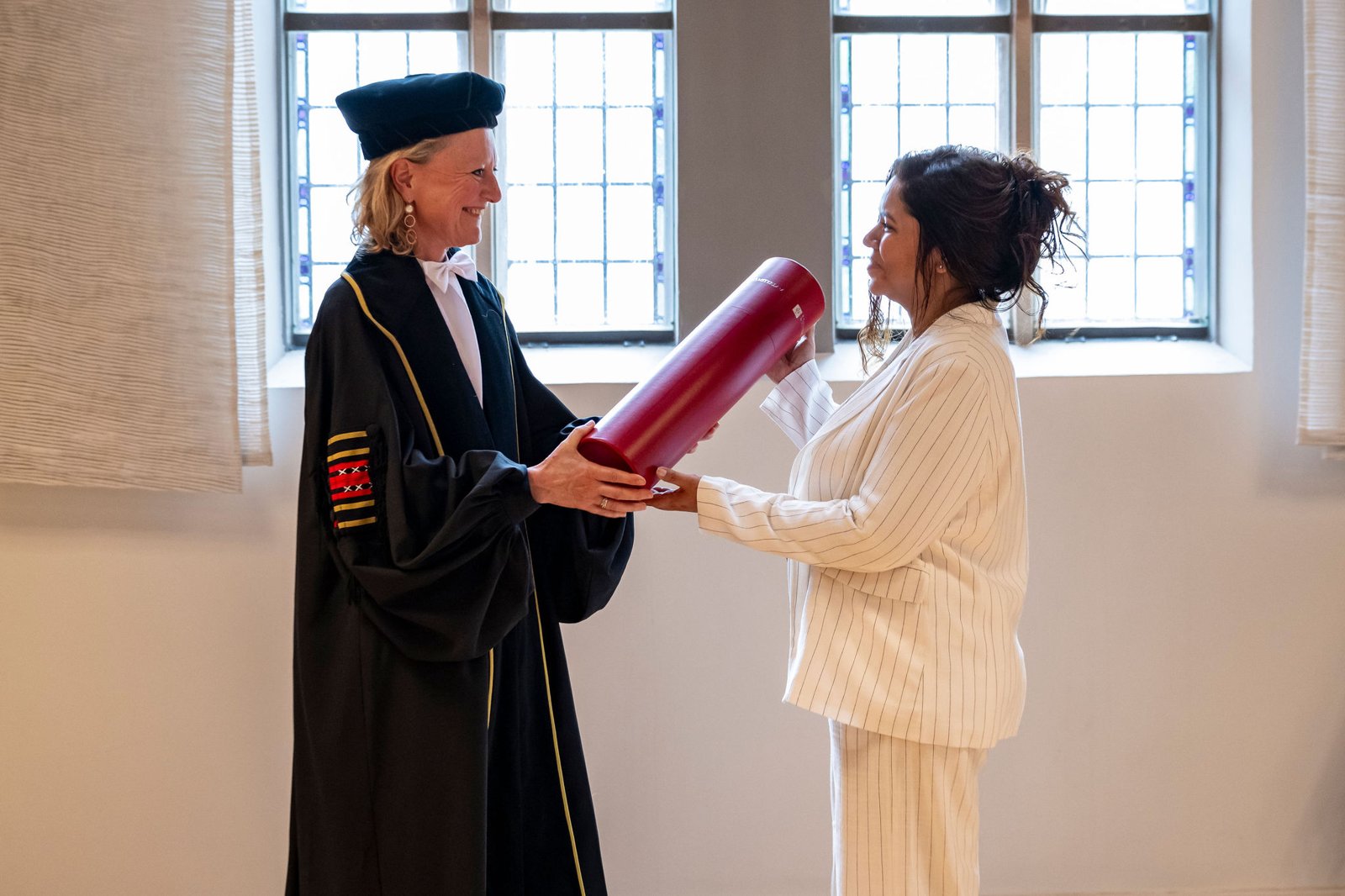
After the committee deliberates, the promoters confer the doctorate, hand over the diploma, and deliver a laudatio (praise speech).

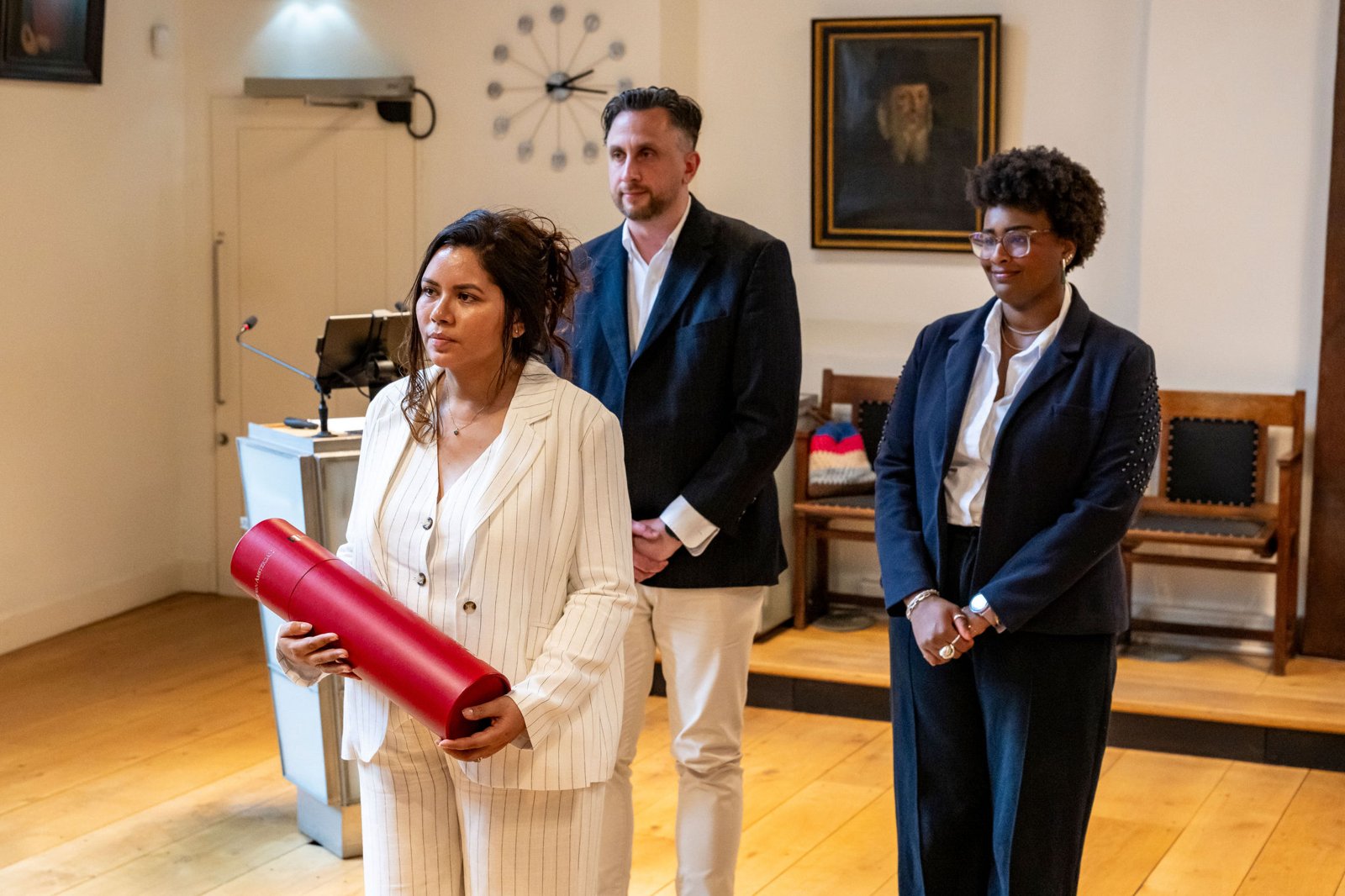
Promotor hands the diploma to Kedma Hamelberg Kedma Hamelberg standing with paranymphs before the verdict
The moment of conferral.

After the defense

Tradition holds that new doctors sign a wall in the Agnietenkapel that has held signatures of PhDs going back decades. My paranymphs, my husband Daniel Hamelberg and my friend Dr. Gabriella Guinlle, stood beside me throughout.

Kedma Hamelberg signing the tradition wall at Agnietenkapel Kedma Hamelberg with paranymphs Daniel Hamelberg and Gabriella Guinlle at the tradition wall Group photo with the Kedma Hamelberg defense committee outside Agnietenkapel
Signing the tradition wall with my paranymphs. Group photo with the committee outside Agnietenkapel.

Dissertation

Voices in Action: AI-Powered Insights from Corporate Messaging During Societal Crises Kedma Hamelberg Promotores: Dr. Umut Konuş, Prof. dr. Willemijn van Dolen Co-supervisor: Prof. dr. Ko de Ruyter University of Amsterdam · Amsterdam Business School · 2026

Available on request via kedma@hamelberg-ai.com.


Photos by Par-Pa Fotografie.

Historical notes on the Agnietenkapel draw on Wikipedia and the University of Amsterdam’s own history page. Historical notes on the paranymph tradition draw on Wikipedia, Erasmus University Rotterdam’s PhD ceremony documentation, and accounts collected by Gildeprint.